%20(1).png)

ARCC is a secure, isolated, private, execution layer for Bitcoin-backed financial agreements. It automates collateral, margin, and settlement enforcement at the contract level—streamlining operations and minimizing risk for regulated institutions.
Built for financial workflows, ARCC enables your institution to launch new Bitcoin-based products with confidence.



Traditional financial systems are not designed to manage the unique properties of digital assets.
ARCC uses advanced Bitcoin primitives to eliminate risks while streamlining operational workflows.

Bitcoin trades and settles continuously, while most post-trade systems rely on batch processing, creating intraday jump risk. ARCC enforces terms in real-time, aligning with Bitcoin’s always-on nature.

When thresholds are breached, enforcement is often delayed by operational processes leaving institutions exposed during volatile conditions. ARCC automates execution at the contract level for immediate protection.

Collateral and margin conditions are often monitored through alerts, dashboards, and manual workflows—introducing strain and human error. ARCC shifts this to automated, contract-embedded logic, reducing operational burden.

As the number of Bitcoin-backed contracts increases, operational complexity scales faster than exposure—requiring extra staff, controls, and processes. ARCC handles this automatically, enabling efficient growth without added overhead.
Automated, Trust-Minimized Collateral Management on Bitcoin

Bitcoin native collateral contracts (like ARCC - Auto Reconciled Collateral Contracts) are automated, programmable agreements built directly on Bitcoin's blockchain. They use Bitcoin itself as collateral for financial contracts (e.g., lending, forwards, or derivatives) without wrapping, bridging, or relying on intermediaries. Enforcement happens through private Smart Channels and HTLCs (Hash Time-Locked Contracts), enabling real-time, trust-minimized execution right on Bitcoin—no sidechains needed.
Traditional systems rely on slow external monitoring and manual fixes, which struggle with Bitcoin’s continuous operation. Native contracts embed enforcement logic on-chain using a deterministic state machine, delivering real-time per-block valuation, automated margin calls, instant settlements, and full on-chain tracking—while preserving self-custody, reducing trust, and integrating seamlessly with existing workflows.
Institutions keep their preferred custody policies (self-custody or qualified providers) with no forced changes. They gain real-time automation for collateral valuation, margin enforcement, and instant settlements of interest, principal, and adjustments. Operations stay private through non-public channels with no intermediaries, and deterministic on-chain execution ensures strong auditability and compliance. This enables banks to scale Bitcoin lending securely and helps capital markets participants manage complex products with better capital efficiency and lower operational risk.
Yes, ARCC supports stablecoins issued as Taproot Assets on Bitcoin. Within the ARCC framework, Taproot Asset–based stablecoins can be incorporated into programmable contracts alongside Bitcoin collateral, enabling automated reconciliation and defined settlement controls.
Our focus remains on providing institutional-grade contract and collateral infrastructure for Bitcoin-native financial activity.
.png)
ARCC provides real-time visibility into contract status, collateralization, and execution state throughout the contract lifecycle.
From Contract Creation to Final Settlement.
ARCC leverages HTLCs (Hash Time-Locked Contracts) to deliver programmable, trust-minimized execution directly on a Bitcoin-native stack eliminating risks associated with wrapped tokens, side-chains, or trusted third-parties.
Collateral is cryptographically locked in a Smart Channel for the duration of the contract. Both counterparties are privy to the contents of the Smart Channel, ensuring contract integrity.
Once the contract matures or hits margin, the Smart Channel automatically responds accordingly, either requesting more margin or triggering liquidation unless more collateral is posted in due time.
The Bitcoin collateral in the smart channel is either returned to borrower upon loan repayment or liquidated to the lender. All settled on-chain for unparalleled transparency.

.png)

Post-trade execution and continuous settlement following contract agreement.
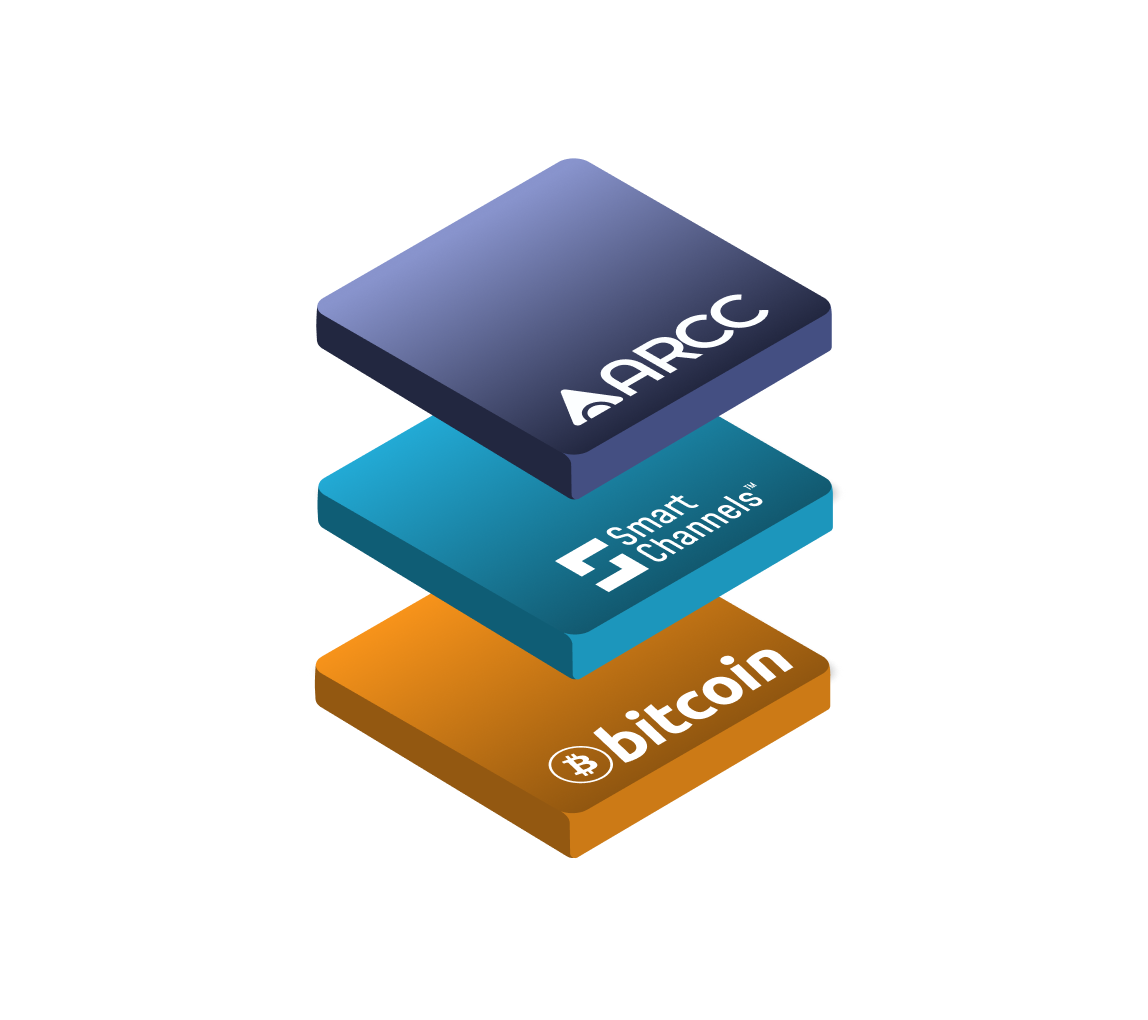
ARCC operates as a post-trade execution layer, sitting between trade origination systems and settlement. It does not replace front-office workflows, core systems, custody, or accounting infrastructure.
Instead, ARCC provides continuous execution of collateral, margin, and settlement terms, integrating alongside existing institutional risk, reporting, and operational systems.
.jpg)

.png)
.png)